


Dog Ate Something Weird? Vet Red Flags vs. At-Home Care

Written by Finn Team · Published September 14, 2026 · Updated September 14, 2026
If your pup ate something strange and now has an upset stomach, the first job is triage, not treatment. Call your vet or an emergency clinic right away for blood in vomit or stool, repeated vomiting, real lethargy, a swollen or painful belly, a suspected toxin, or a swallowed object like a sock or corn cob. If none of that applies and your dog is bright and drinking, a short food rest plus a bland diet is the standard at-home plan.
When should I call the vet after my dog ate something weird?
Call now, before trying anything at home, if any of these are present. They separate mild dietary indiscretion from something needing hands on your dog.
- Blood anywhere. Red streaks, or black, tarry, coffee-ground material.
- Repeated vomiting. More than 2 or 3 episodes, or a pup who cannot keep water down. Foreign material in the vomit is its own red flag.
- Unproductive retching with a bloated or tender belly. An emergency, especially in deep-chested breeds.
- Lethargy or weakness. A dog who will not get up, wobbles, or hides.
- Suspected toxin. Xylitol, grapes or raisins, chocolate, onions, marijuana, rodent bait, antifreeze, human medication, or anything unknown.
- Suspected object. Socks, string, hair ties, rocks, cooked bones, corn cobs, peach pits, toy squeakers.
- Straining to poop with little coming out, or crying when picked up.
- Symptoms past 24 to 48 hours, or any symptoms at all in a puppy, senior, toy breed, pregnant dog, or pup with diabetes or a history of pancreatitis.
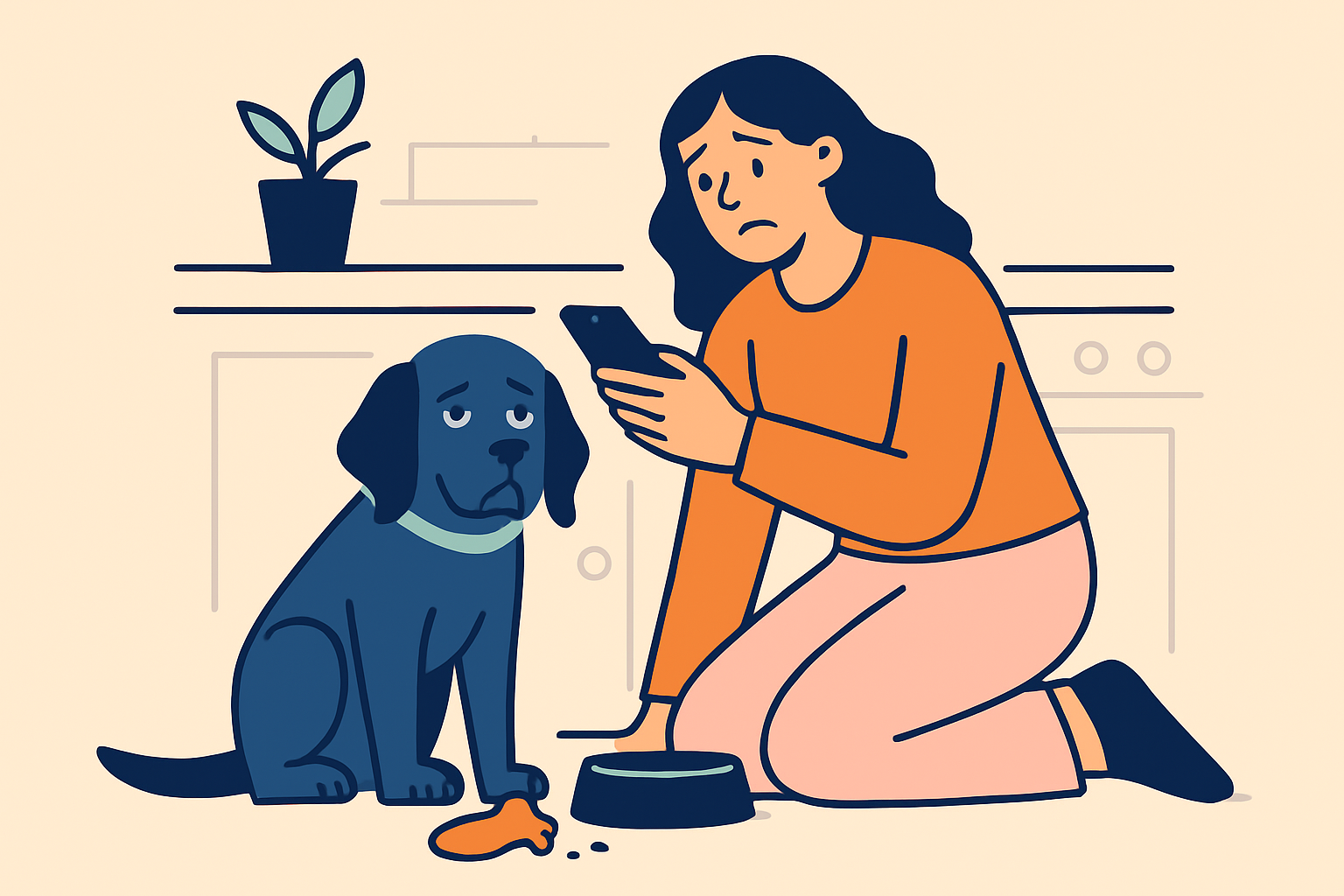
What if I do not know what my pup swallowed?
Treat an unknown ingestion as a vet question, not a home project. Save the evidence (packaging, chewed-up remains, a photo of the vomit) and call your vet or the ASPCA Animal Poison Control Center at (888) 426-4435 with the time, amount, and your dog's weight.
Do not try to make your dog vomit on your own. The ASPCA's toxicologists warn that salt, olive oil, ipecac, and finger-gagging are unsafe or simply do not work, and that even hydrogen peroxide should only be used under guidance from a veterinary professional. Some substances do more damage coming back up.
Swallowed objects deserve the same caution. Many items pass uneventfully, but obstruction is one of the more common life-threatening problems vets see, with vomiting, appetite loss, straining, belly pain, and lethargy as usual signs. Time matters, because a blocked intestine loses its blood supply.
What is the step-by-step bland diet protocol?
This is for otherwise healthy adult dogs with mild signs who are alert and drinking. If things are not clearly improving by 48 hours, stop and call your vet.
- Remove access and bag whatever they got into for your vet.
- Rest the gut briefly. After vomiting, hold off on food and water for 1 to 2 hours, then offer ice chips or a quarter cup of water every 20 to 30 minutes. Many vets withhold food (never water) for 6 to 12 hours, up to 24 in a healthy adult. Skip the fast for puppies, seniors, toy breeds, and dogs with medical conditions, and never go past 24 hours without vet input.
- Start bland and small. Boiled skinless, boneless chicken breast with plain white rice, roughly 1 part chicken to 2 parts rice, no oil, salt, butter, or seasoning. Feed about a quarter of normal daily volume on day one, split into 4 to 6 tiny meals every 6 to 8 hours.
- Build back up. If food stays down 12 hours and stool improves, work toward normal volume in frequent small meals.
- Transition back to regular food over 3 days, not all at once. Chicken and rice is not nutritionally complete, so 5 days is the ceiling unless your vet says otherwise.
- Watch the output. Log every vomit and stool with a time and description. It is the most useful thing you can hand a vet.
| Timeline | Feed | Watch for |
|---|---|---|
| Hours 0 to 12 | Small amounts of water, no food | Any red flag above |
| Day 1 | 25% of normal volume as chicken and rice, 4 to 6 mini meals | Food staying down 12 hours |
| Day 2 | 50% to 75% of normal volume, small meals | Stool firming, appetite back |
| Days 3 to 5 | Taper: 75/25 bland to regular, then 50/50, then 25/75 | Normal stool by day 5 |
Can a probiotic fix an upset stomach after an unknown ingestion?
No, and this gets glossed over online constantly. A supplement does nothing for a toxin in the bloodstream and nothing for a hair tie stuck in the small intestine. If there is any chance your pup swallowed something toxic or obstructive, supplements are not part of the plan. Diagnostics are. Digestive support belongs in the recovery phase, and it is the wrong tool while a dog is actively vomiting.
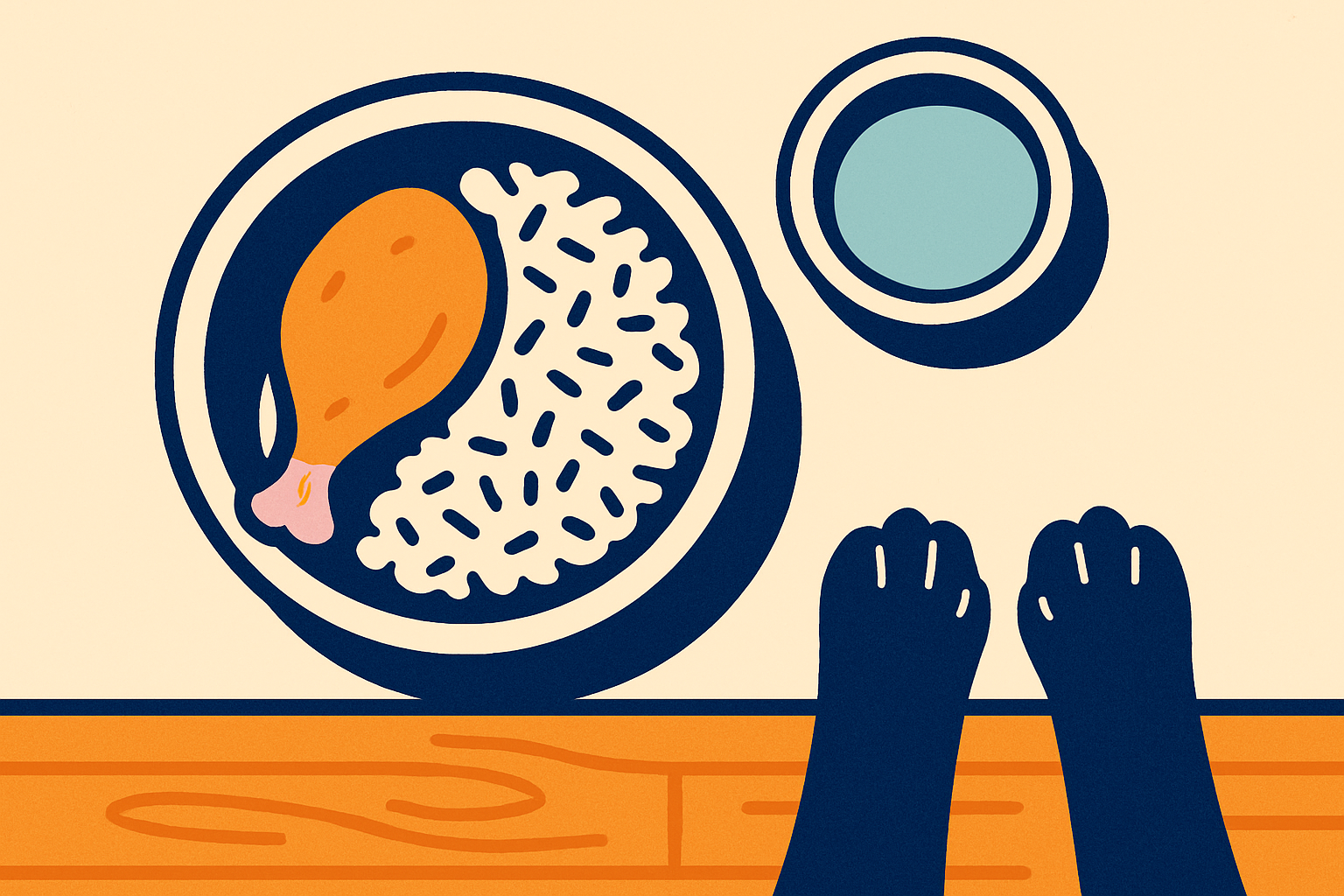
How do I support recovery once an emergency is ruled out?
Once your vet has cleared your pup, the goal shifts to settling the gut and reducing the odds of a repeat. Dietary indiscretion disrupts gut bacteria, which is often why stool stays loose for days after a pup feels fine. A multi-strain probiotic with a prebiotic is a reasonable helper. In one controlled trial in dogs with acute gastroenteritis, the probiotic group reached normal stools in about 1.3 days versus 2.2 on placebo. A nudge, not a rescue. For comparing products, see our piece on which probiotic a vet would actually pick.
Look for three things: vet-formulated to a defined strain count, the NASC Quality Seal (an independent audit every two years, strict labeling rules, adverse event reporting, and random testing by outside labs), and third-party testing for potency and contaminants. Plenty of products skip all three.
Finn's Digestive Probiotics is a vet-formulated, NASC-sealed, third-party tested soft chew with pumpkin and multi-strain probiotics, made for this window: settling the gut during a bland-diet transition and supporting firmer stools after.
Shop Digestive ProbioticsIf stool stays soft afterward, a fiber topper like Pumpkin Plus can help with regularity. And if the upset shows up in predictable situations, the trigger may not be a mystery snack at all: see our guide to travel-related tummy trouble.
FAQ
How long should a mild upset stomach last?
Most cases improve within 24 to 48 hours and resolve in 3 to 5 days. Symptoms still going at 48 hours, or worsening at any point, means it is time for an exam.
Should I give my dog Pepto-Bismol or Imodium?
Not without your vet's okay. Human GI medications can be unsafe for some dogs, can mask signs of a blockage, and dosing errors are easy.
My dog ate a sock and seems fine. Do I still call?
Yes. Objects can sit in the stomach for days before causing trouble, and a dog can look normal right up until they do not. Your vet may suggest X-rays or observation.
This article is for general education and is not a substitute for veterinary advice. If your pup has ongoing or severe symptoms, check in with your vet.